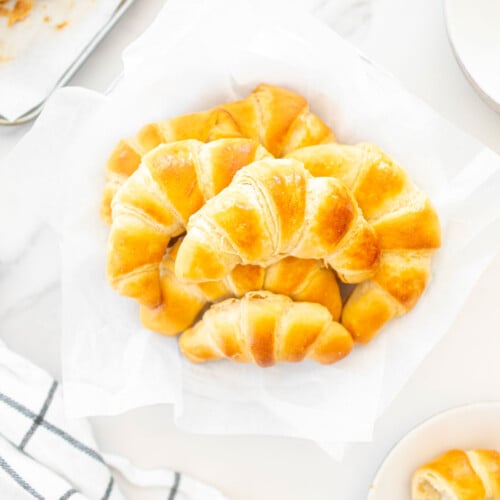
Sourdough Crescent Rolls

Discover the tangy delight of Sourdough Crescent Rolls. This recipe transforms sourdough discard into buttery, flaky perfection.
Equipment
- Digital Food Scale
- Stand Mixer
- Mixing Bowl
- Half Sheet Pan
- Parchment Paper Sheets
- Rolling Pin
- Pastry Brush
Ingredients
Dough
- 28 grams honey
- 7 grams active dry yeast
- 170 grams milk
- 113 grams sourdough discard
- 42 grams salted butter (softened and cubed)
- 300 grams all purpose flour
- 6 grams salt
Filling
- 113 grams salted butter (softened)
Topping
- 1 egg
Instructions
- Activate the yeast: Whisk the honey, milk, and yeast in a large bowl. Cover and let the yeast bloom until foamy, at least 15 minutes.
- Make the dough: Whisk the sourdough discard into the yeast mixture until fully incorporated.
- Add the all purpose flour and salt to the bowl of a stand mixer fitted with the paddle attachment (alternatively, you can use a large mixing bowl with your hands). Add in the softened cubed butter and mix with the dough hook to combine into the flour and butter mixture looks like coarse crumbs. If not using a mixer, just rub the butter and flour together with your fingers.
- Create a well in the center and pour the yeast mixture in. Knead on speed 2 to 4 until no traces of dry flour remain. Then continue to knead until it looks cohesive and smooth (about 5 to 10 minutes). (If doing with your hands, it may become sticky. If this happens, cover the bowl with plastic wrap and allow it to rest for 15 minutes and come back to it.)
- Bulk ferment: Transfer to a lightly greased mixing bowl and round the dough into a tight ball and cover with plastic wrap. Let the dough rise until doubled in volume, about 45 minutes to 1 hour (depending on the temperature of your kitchen). It helps to keep it in a warm place.
- Line a baking sheet with parchment paper.
- Laminate the dough: Divide the dough into 5 even portions (you can just eyeball this). Roll each portion of dough into a ball. If it seems sticky, you can cover the dough with plastic wrap and let it rest for 10 minutes, this will make it easier to roll out. I had no issues rolling out right away though.
- Lightly flour the dough balls and working with 1 portion of dough at a time, roll the dough into an 8-inch circle using a rolling pin. Transfer the dough to the prepared baking sheet.
- Spread 1 tablespoon of butter on top of the circle of dough. Repeat with the remaining portions of dough, stacking each circle of dough on top of the previous one and spreading 1 tablespoon of butter on top, but do not spread butter on the top layer! Pinch the edges of the dough together so the layers do not separate.
- Cover with plastic wrap and chill the dough for 1 hour.
- Preheat the oven to 350°F.
- Shape the dough: Place the dough on a clean work lightly floured surface. Use a rolling pin to roll it out into a large circle, about 15 to 18 inches, it should be quite thin (⅛-inch thick). Using a pizza cutter or chef’s knife, cut the dough into 12 even segments (like a pizza).
- Working with 1 triangle at a time, make a small slit in the middle of the base of the triangle. This will allow the dough to be curved into its iconic shape, so it’s important to make this cut.
- Pull the two bottom corners outward and roll the dough towards the tip. Place the crescent roll shapes back on the parchment paper lined baking sheet and curve the ends so that the dough resembles a crescent shape (give the dough room to rise and spread a little bit). Repeat with the remaining portions of dough.
- Final proof: Cover the baking sheet with plastic wrap and let the dough rise until puffy and has noticeably increased in volume, about 30 to 45 minutes.
- Whisk the egg. Using a pastry brush, brush the tops of the dough with egg wash.
- Bake for 20 to 30 minutes or until the crescent rolls are golden brown. These rolls are best served fresh out of the oven.
Video
Notes
Tips
- Weigh your ingredients for the best results.
- You can use instant yeast if you’re in a hurry or if you’re out of active dry yeast.
- Make sure your yeast activates and is not expired. If it doesn't turn foamy, then that means your dough won't rise.
- Make sure to let your dough rise fully, don't just go off an amount of time, look for visual signs that the dough is ready.
- Make sure your butter is soft, especially for spreading it onto each layer of dough as the dough is very thin.
- I use a pizza cutter to cut the dough into triangles, but a sharp knife will also work!
- These are best enjoyed fresh out of the oven!
- High Altitude — Follow the recipe as noted.
Nutrition
Calories: 206kcalCarbohydrates: 22gProtein: 4gFat: 12gSaturated Fat: 7gPolyunsaturated Fat: 1gMonounsaturated Fat: 3gTrans Fat: 0.4gCholesterol: 43mgSodium: 288mgPotassium: 63mgFiber: 1gSugar: 3gVitamin A: 366IUVitamin C: 0.01mgCalcium: 27mgIron: 1mg
Want more recipes?Follow along on @mimisorganiceats for more inspiration!