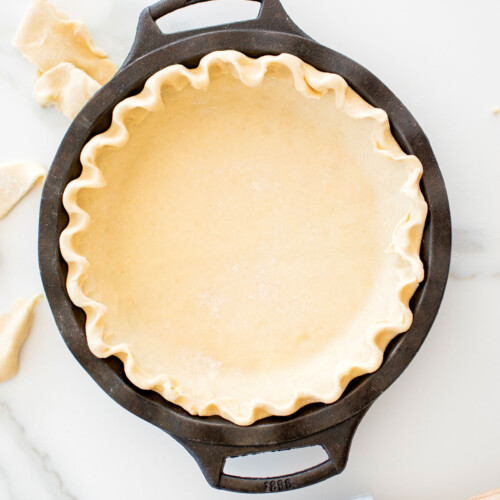
How to Parbake a Pie Crust

Learn how to parbake a pie crust with this easy step by step tutorial that includes photos and a video! Use this for any recipe that calls for a parbaked pie crust.
Equipment
- Digital Food Scale
- Stand Mixer (optional)
- 9-Inch Pie Pan
- Rolling Pin
- Parchment Paper Sheets
- Pie Weights
Ingredients
- 127 grams all purpose flour (plus extra for rolling)
- 113 grams salted butter (cold)
- ¼ cup cold water
Instructions
- In the bowl of a stand mixer fitted with the paddle attachment add the flour.
- Remove the butter from the fridge and chop into small cubes. The smaller the cubes, the flakier the crust: Cut the stick of butter into four and then chop into small cubes from there. Add the cold, cubed butter to the flour mixture. Measure out the cold water and have it ready.
- Turn the mixer on low and slowly start to incorporate the ingredients. Gradually turn the mixer to medium speed. Once the butter mixture looks like wet sand, immediately add in all the cold water. As soon as the dough comes together, stop the mixer.
- Have a piece of plastic wrap ready and form it into a disk and wrap in plastic wrap. Allow to chill in the fridge for at least 4 hours or overnight.
- Preheat the oven to 350°F. Grease a 9-inch pie pan with butter.
- Remove the pie dough from the fridge. Remove the plastic wrap and place on a floured surface. Roll out the into a disk that is ¼-inch thick, it should be about 11-inches in diameter. Place the pie dough into the pie pan and press lightly to form against the pan. It should be large enough that the dough folds right over the top of the pan.
- Roll the excess dough into the pie pan so it’s even with the edges of the pie pan. Flute the edges by using your thumb and index finger of your right hand to pinch the rolled edge of dough and push your index finger of your left hand into it to create the “flute”. Continue around the entire pie to flute the edges.
- Place a piece of parchment paper into the pie pan and form it to the sides. Add rice or pie weights and parbake for 20 minutes.
- Remove the parchment paper and weights, and bake for another 5 minutes. (If you need to blind bake, instead of baking for only 5 minutes at this step, bake for 15 to 20 minutes or until the crust looks completely done and is lightly golden brown.)
- Use this partially baked crust for any recipe that calls for a parbaked pie crust.
Notes
Tips
- Always weigh ingredients for the best results.
- You need parchment paper, you cannot do this without it as this is what separates the pie crust from the pie weights.
- You don't need fancy or expensive pie weights. You can simply use rice, quinoa, or even beans. I use rice as I like that it's very small so it can get into the corners of the fluted pie crust well which ensures it holds it shape as it bakes. I reuse the same rice as "pie weights" and just store it in an airtight container in my pantry to reuse every time.
- You can use this recipe for any pie recipe that calls for a partially baked crust.
- If you need a pie crust that is fully blind baked (completely baked) to add pudding or something into it, you can just bake this for 15 to 20 minutes on the second bake, or until it looks golden brown and done.
- High Altitude — Bake for 15 minutes, remove pie weights and then bake again for another 5 minutes. (If you need to blind bake, instead of baking for only 5 minutes at this step, bake for an additional 15 to 20 minutes or until the crust looks completely done and is lightly golden brown).
Nutrition
Calories: 159kcalCarbohydrates: 12gProtein: 2gFat: 12gSaturated Fat: 7gPolyunsaturated Fat: 0.5gMonounsaturated Fat: 3gTrans Fat: 0.5gCholesterol: 30mgSodium: 92mgPotassium: 20mgFiber: 0.4gSugar: 0.1gVitamin A: 353IUCalcium: 6mgIron: 1mg
Want more recipes?Follow along on @mimisorganiceats for more inspiration!