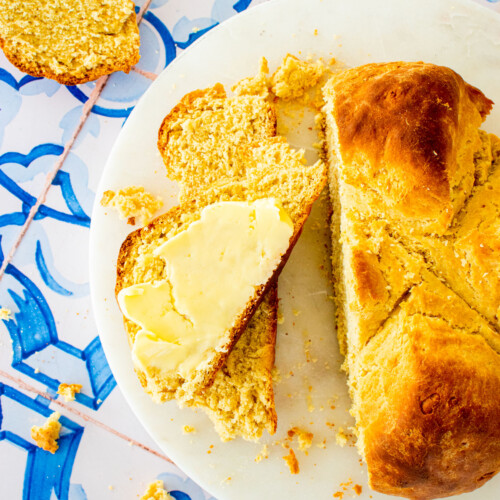
Sourdough Irish Soda Bread

This Sourdough Irish Soda Bread is an easy no rise bread that uses up sourdough discard! This classic St. Patrick’s Day bread is delicious any time of year!
Equipment
- Digital Food Scale
- Stand Mixer
- Cast Iron Skillet
Ingredients
- 300 grams all purpose flour (plus for more kneading)
- 4 grams fine sea salt
- 3 grams baking soda
- 113 grams sourdough discard
- 226 grams buttermilk
- 56 grams salted butter (cold cut in cubes)
Instructions
- Line a baking sheet or 10-inch skillet with parchment paper.
- In the bowl of a stand mixer fitted with the paddle attachment, add the flour, salt, and baking soda. Mix for 2 to 3 rotations to combine.
- Combine the buttermilk and sourdough discard until completely dissolved. Set aside the buttermilk mixture. Make sure the discard has fully dissolved or you may end up with gummy spots in your bread.
- Cut the chilled butter into small cubes and add to your stand mixer. Mix until the mixture looks like wet sand (similar to if you make pie dough in your mixer!).
- With the mixer on low, slowly pour in the buttermilk and sourdough discard mixture until the dough comes together, it will look like a sticky dough and not smooth.
- Cover the bowl with a tea towel and let it rest for 10 to 15 minutes. This will allow the flour to thoroughly hydrate. After the rest period, the dough should feel less sticky and be easier to work with.
- Preheat the oven to 425°F.
- Dust a clean work surface with 1 tablespoon of flour (about 7 grams, but you can use more if needed). Turn your dough out onto your floured surface. Knead the dough 4 to 5 times until your dough looks smooth. Make sure your dough is smooth or your bread may end up with gummy spots.
- Using the edge of your palms, round the dough into a tight ball. Transfer the dough on your prepared baking sheet or skillet.
- With a bench scraper (or a sharp knife), cut the dough into quarters (like a deep cross or X). Cutting the dough through allows your loaf to bake completely in the center. Pinch the edges together so the dough bakes into a round loaf and doesn’t separate.
- Bake the dough for 30 to 45 minutes or until the loaf is golden brown and registers at least 200°F when probed with an instant-read thermometer. (If you're baking at high altitude, be sure to check the Notes at the bottom of the recipe for high altitude baking instructions).
- Let it cool completely before cutting for nice clean cuts.
Video
Notes
Tips
- Always weigh ingredients for the best results.
- Use cold butter, straight from the fridge.
- Make sure the butter is coated in flour. This process is very similar to making pie dough in your stand mixer. So, if you are familiar with that, then it’s the same thing! This prevents excessive gluten from developing which results in soft and fluffy soda bread!
- Let the dough rest. Don’t skip this part, as it’s incredibly important! The gluten has to relax in order for the dough to be shaped smooth, and that’s why this step is so important. It will make the dough way less sticky and you’ll be able to shape it into smooth ball.
- Knead the dough until smooth. It needs to be smooth and not sticky, so you can slice it with a knife. Slicing this bread into 4 quarters allows the inside to bake completely while also providing this bread with a crisp crust and tender light crumb.
- Use an instant-read thermometer to check to see if your bread is done. This one should register 200°F when probed, before you pull it out! Also, look for a golden brown crust.
- If you want add in additions to this traditional soda bread, you can add in raisins, caraway seeds, dried cranberries, orange zest, currants, or even something fun like chocolate chips! I recommend about 113 grams of whatever ingredient you want to add in.
- Store at room temperature covered. I like to keep mine in my cake dome!
- High Altitude — Bake for 30 minutes or until the loaf is golden brown and registers at least 200°F when probed with an instant-read thermometer.
Nutrition
Calories: 163kcalCarbohydrates: 24gProtein: 4gFat: 6gSaturated Fat: 3gPolyunsaturated Fat: 0.3gMonounsaturated Fat: 1gTrans Fat: 0.2gCholesterol: 15mgSodium: 297mgPotassium: 64mgFiber: 1gSugar: 1gVitamin A: 177IUCalcium: 32mgIron: 1mg
Want more recipes?Follow along on @mimisorganiceats for more inspiration!